In 1678, the first woman to earn a doctoral degree from a university received her doctorate in philosophy in Italy. In England, an amendment to the Test Act barred Catholics from membership in both houses of Parliament. In North America, the French explorer La Salle began constructing what some consider the first ship to sail the Great Lakes, named Le Griffon. (It disappeared, along with its crew and cargo of furs, somewhere in Lake Michigan the following year.) And in Connecticut, Joshua Bushnell built a two-room post and beam house with a thatched roof on what is now the Post Road in Old Saybrook.
The imposing salt-box you see today, if you happen to glance up from the traffic and look over at the grey-brown building set back from the road, has evolved and expanded over the 200 years it was owned by the Bushnell family. If you look closely, you can also spot some of the outbuildings on the property, which include five other structures still in their original locations. One of them is a barn; another is disconcertingly called the Slave House. In some contexts this can mean a building where people were imprisoned before being sold into slavery; here, absent a definition in any source I can find, my guess is that it meant the dwelling of enslaved people belonging to the Bushnell family. (Educational programs at New London's Joshua Hempstead House, built the same year, are partially devoted to the experiences of the Hempsteads' slaves.)
Bushnell Farm, as it is sometimes known (it's also called the Elisha Bushnell House or the Older Bushnell House) is not a museum. It is privately owned. It's not open to the public, except on special occasions like Old Saybrook's 375's birthday in 2010, or for events like children's summer camps and seasonal celebrations.
Now that the farm's 22 acres are surrounded by the distracting buzz of modernity, the house is easy to miss. But if you're in Old Saybrook, keep an eye out for 1445 Boston Post Road. This is one of the five oldest remaining houses in Connecticut, and even a quick glance at it will give you a little glimpse of how it must have been to live here 337 years ago.
(And if you were wondering, yes, this is the same Bushnell family that produced David Bushnell, inventor of the first submarine - there's a replica of it at the Connecticut River Museum in Essex - and Horace Bushnell, namesake of Hartford's Bushnell Park and Bushnell Center for the Performing Arts.)
Showing posts with label Old Saybrook. Show all posts
Friday, December 11, 2015
Wednesday, September 9, 2015
Fun Company & Swag | Two Shoreline Shops
FUN COMPANY, STONINGTON
These two stores on the Connecticut shoreline might not be exactly alike in dignity, but they share certain attributes that made me want to combine them into one post. They're both great for rummaging and finding surprises, they're both a safe bet if you need to buy a gift, and they both offer substantial discounts - which is not to say that all their goods are inexpensive (far from it), just that you can find very good deals if you look.
Fun Company in Stonington calls itself "the original sample outlet." The front room is filled with discount "designer" clothing (I put designer in quotes because I've never heard of most of the brands I've seen there, but that probably says more about me not being a colorful printed tunic person than anything else) children's things, and assorted sundry gift-y items. The back room is temptingly packed with linens - sheets, comforters, pillow shams, and so on, also discounted, and more little gifts. (I'm talking about the Cutler Street location; there is another, on Water Street, which carries mostly clothing and accessories.)
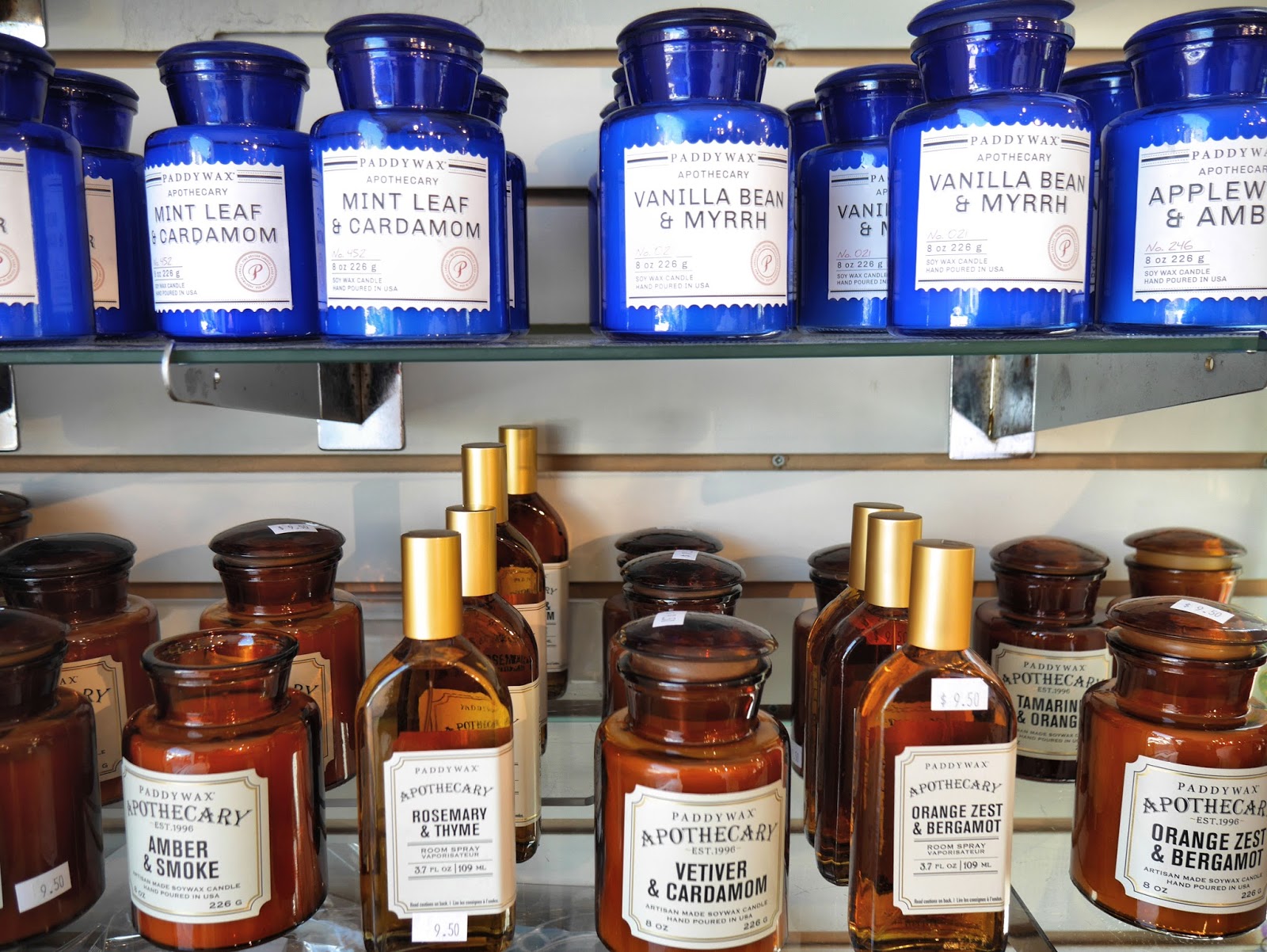
The reason I love Fun Company (or Fun, or FUN; I've seen it written all of these ways, I don't even know which is right, does it matter?) is for its stock of candles. This store has become my secret source for impressively inexpensive fancy candles that smell approximately 9,000 times better than the icky ones you can buy at those two candle stores in the mall. (Which shall remain nameless, though at least it's clear what their names are.)
I also love this place because sometimes while you are shopping a cat will appear, looking like a puff of black cotton candy with round yellow eyes, and push its little head into your hand while refusing to pose for photos.
Fun Company in Stonington calls itself "the original sample outlet." The front room is filled with discount "designer" clothing (I put designer in quotes because I've never heard of most of the brands I've seen there, but that probably says more about me not being a colorful printed tunic person than anything else) children's things, and assorted sundry gift-y items. The back room is temptingly packed with linens - sheets, comforters, pillow shams, and so on, also discounted, and more little gifts. (I'm talking about the Cutler Street location; there is another, on Water Street, which carries mostly clothing and accessories.)
The reason I love Fun Company (or Fun, or FUN; I've seen it written all of these ways, I don't even know which is right, does it matter?) is for its stock of candles. This store has become my secret source for impressively inexpensive fancy candles that smell approximately 9,000 times better than the icky ones you can buy at those two candle stores in the mall. (Which shall remain nameless, though at least it's clear what their names are.)
I also love this place because sometimes while you are shopping a cat will appear, looking like a puff of black cotton candy with round yellow eyes, and push its little head into your hand while refusing to pose for photos.
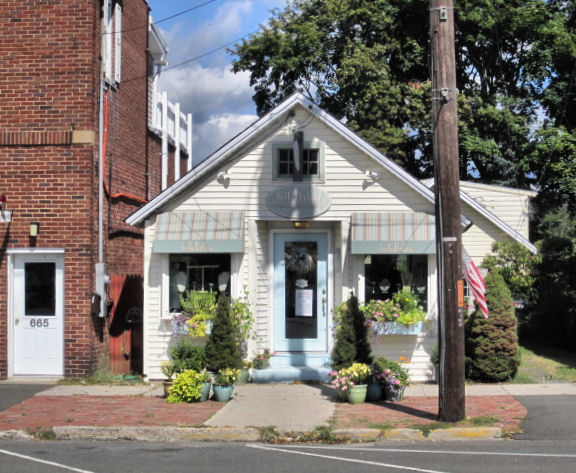
Swag on Main Street in Old Saybrook is, well, random. That may be the most overused word of the decade - it's certainly the most overused word by me - but I have to use it here because, damn me if this place is not a collection of pure random. There's art, pretty soaps, clocks, greeting cards, candy, gag gifts, napkins, baby paraphernalia, a seasonal holiday section, and furniture. There's outdoorsy stuff, like insulated bags to tote around your chilled beverages, and a lot of beachy home accessories, like quotes about the beach printed on painted driftwood. There are magnets and pins and lanterns and I don't even know what, and it all changes regularly, so by the time you get there it might have different things entirely. (Like Fun Company, Swag - or SWAG - again, I don't know - also has a second store across the street for clothes and accessories.)
When I went to Swag to take these pictures I bought a tiny cotton flag with my first initial on it, which I don't need but I almost thought I needed at that moment because it was very cute and it cost $1. And that pretty much sums up shopping at Swag.
FUN COMPANY, STONINGTON
SWAG, OLD SAYBROOK
SWAG, OLD SAYBROOK
SWAG, OLD SAYBROOK
SWAG, OLD SAYBROOK
SWAG, OLD SAYBROOK
Monday, October 8, 2012
Old Saybrook, Wednesday Morning
This pic didn't make it into last week's post on Old Saybrook. I guess I figured it was so cute it deserved its own post.
Friday, October 5, 2012
Main Street, Old Saybrook
I thought I pretty much had Old Saybrook figured out. Not that I go there all that often, but I knew roughly what box to put it in. (What, you don't mentally store towns in boxes?) Old Saybrook definitely belonged in the Madison/Guilford box. The "perfect New England town where everything is just so" box, the "seems snootier at first glance than it really is because it's so pretty" box, the "here be gambrel roofed 19th century houses and exclusive boutiques and tasteful yet winking decorative references to the sea."
But I'd never simply walked down Main Street and looked around. I'd parked there to go into a store or two, and admired the floral arrangements between the lanes while driving to the shoreline. But I'd never just wandered. And you can't really see places without wandering. And often when you wander, what you find is less perfect than what you see at faster speeds, and better.
Wednesday, September 19, 2012
Tour 1 (Part 3 of 4)
(Part 1. Part 2.)
Finally. I was getting somewhere. I hurried through New Haven where Route 1 jags and twists, more an obstacle course built to confuse than a road, and East Haven, which the Guide describes ambiguously as "receiving the overflow from many of New Haven's expanding activities." I glimpsed Lake Saltonstall, where a gentleman of that venerable Connecticut family once spent an angry day stranded by the tide after a dispute with a ferry-woman. I passed into Branford, always nicer than I remember it being, always inexplicably merging with Westbrook in my mind. (Branford was named for Brentford, England, because...who needs spelling?) Then on to Guilford, where Route 1 passes north of the picture-perfect center of the town.
This was the part of US 1 that I knew and loved.
This was the Connecticut of toy-sized boutiques on dainty Main Streets, of enormous lobsters on top of diners, of rickety shoreline motor inns with hokey signs like portals to eras past. The Guide went on about certain ancient salt-box houses once owned by important people, but practically every house was lovely, painted in perfectly contrasting New England colors, and historic - with a plaque to prove it.
And about those houses:
In Madison, the Guide said, "Early industries were fishing, shipbuilding, and the burning of charcoal." And, "US 1 proceeds past many restaurants and hotels where 'shore dinners' are a specialty." And finally, the ultimate travel-writer-fatigue sentence, the sentence you get when you finally abandon all hope of coming up with the right words: "Occasional water scenes and rural landscapes offer diversified scenery."
Next was Clinton, about which the Guide says, "The manufacture of Pond's Extract from native witch hazel cut in back-country brush lots and sometimes distilled in backwoods stills, is the town's chief industry."(Today the chief industry may or may not be outlet stores.)
I've driven this road many times, but this was the first time I took time find out what exactly this brick building is. It's called "Old Brick" or the Elisha White House, and belongs to the Clinton Historical Society. It was built in 1750 and is "the oldest brick house on the shoreline from New Haven to New London." The Guide doesn't mention it, possibly because the length of this Tour was giving the writers a headache. (It gave me a headache.) They do mention a milestone placed along the "highway" by Benjamin Franklin, and a detour down a road "lined with tiny fisherman's cottages" which today leads to the Town Beach.
They also note this cannon on the Green - it looks even smaller in real life than this picture conveys - which they say was "used by Gideon Kelsey in his single-handed defense of the local coast line against the British invasion of 1812." Clinton's role in the war of 1812 is, well, not something people really mention a lot, as opposed to that of Stonington (heroic and improbable), Madison (feisty and clever) and Essex (oops.) But apparently something happened here. The above plaque claims this cannon "saw service during the war." Another account has Kelsey shooting at a British ship in the Sound with his "old king's arm," i.e. not a cannon. In any case, if some nutty Republican ever makes it mandatory for everyone to own a gun, let me just say I want this one. So cute!
As I made my way east along the old Post Road, there were signs of fall that didn't quite match up to the still-warm temperature.
And in Westbrook, which Route 1 zips through pretty quickly, there was...this.
Old Saybrook, which then had a population of just 1,643, was conspicuously left out of the itinerary, and mentioned only as the place where US 1 - not yet I-95 - crossed the "broad stream" of the Connecticut River.
On the other side, the Guide told of an Old Lyme invisible to the modern eye. There was something called the "Mile of Roses," which I thought an ephemeral thing to include in a guidebook; the "hamlet of Laysville...once the center of a small woolen industry"; and the Stone Ranch Military Reservation, which is still there (and called Stones or Stone's Ranch) but, appropriately for a Department of Defense training site, not exactly advertising its presence.
In East Lyme, there were white fences and apple trees, each with a different-colored fruit.
Waterford was more egregiously snubbed than Old Saybrook; there was no mention of the town at all. Waterford is rather large to ignore completely, and in doing so you run the risk of looking like you've forgotten it, which would be embarrassing. I wondered if someone there had been unusually rude to the writers.
And then I was home, in my "historic maritime town" of New London. But there were still a few miles left to go.
Finally. I was getting somewhere. I hurried through New Haven where Route 1 jags and twists, more an obstacle course built to confuse than a road, and East Haven, which the Guide describes ambiguously as "receiving the overflow from many of New Haven's expanding activities." I glimpsed Lake Saltonstall, where a gentleman of that venerable Connecticut family once spent an angry day stranded by the tide after a dispute with a ferry-woman. I passed into Branford, always nicer than I remember it being, always inexplicably merging with Westbrook in my mind. (Branford was named for Brentford, England, because...who needs spelling?) Then on to Guilford, where Route 1 passes north of the picture-perfect center of the town.
This was the part of US 1 that I knew and loved.
This was the Connecticut of toy-sized boutiques on dainty Main Streets, of enormous lobsters on top of diners, of rickety shoreline motor inns with hokey signs like portals to eras past. The Guide went on about certain ancient salt-box houses once owned by important people, but practically every house was lovely, painted in perfectly contrasting New England colors, and historic - with a plaque to prove it.
And about those houses:
"Many Madison houses include one of Connecticut's usual domestic features, the cat-hole. The Yankee, always thrifty, deplored the necessity for holding doors open on cold wintry nights for the house cat to go out and in. Some early craftsmen cut a round opening in the lower panel or rail of a door, fitted a swinging cover over it and solved the problem by teaching the family tabby to push her own door open. Some cat-holes have a little peak-roofed portico to protect them from the weather."I have never seen one, but I've never carried through with my plan to sneak through all the backyards of Madison looking for one, either.
In Madison, the Guide said, "Early industries were fishing, shipbuilding, and the burning of charcoal." And, "US 1 proceeds past many restaurants and hotels where 'shore dinners' are a specialty." And finally, the ultimate travel-writer-fatigue sentence, the sentence you get when you finally abandon all hope of coming up with the right words: "Occasional water scenes and rural landscapes offer diversified scenery."
Next was Clinton, about which the Guide says, "The manufacture of Pond's Extract from native witch hazel cut in back-country brush lots and sometimes distilled in backwoods stills, is the town's chief industry."(Today the chief industry may or may not be outlet stores.)
I've driven this road many times, but this was the first time I took time find out what exactly this brick building is. It's called "Old Brick" or the Elisha White House, and belongs to the Clinton Historical Society. It was built in 1750 and is "the oldest brick house on the shoreline from New Haven to New London." The Guide doesn't mention it, possibly because the length of this Tour was giving the writers a headache. (It gave me a headache.) They do mention a milestone placed along the "highway" by Benjamin Franklin, and a detour down a road "lined with tiny fisherman's cottages" which today leads to the Town Beach.
They also note this cannon on the Green - it looks even smaller in real life than this picture conveys - which they say was "used by Gideon Kelsey in his single-handed defense of the local coast line against the British invasion of 1812." Clinton's role in the war of 1812 is, well, not something people really mention a lot, as opposed to that of Stonington (heroic and improbable), Madison (feisty and clever) and Essex (oops.) But apparently something happened here. The above plaque claims this cannon "saw service during the war." Another account has Kelsey shooting at a British ship in the Sound with his "old king's arm," i.e. not a cannon. In any case, if some nutty Republican ever makes it mandatory for everyone to own a gun, let me just say I want this one. So cute!
As I made my way east along the old Post Road, there were signs of fall that didn't quite match up to the still-warm temperature.
And in Westbrook, which Route 1 zips through pretty quickly, there was...this.
Old Saybrook, which then had a population of just 1,643, was conspicuously left out of the itinerary, and mentioned only as the place where US 1 - not yet I-95 - crossed the "broad stream" of the Connecticut River.
On the other side, the Guide told of an Old Lyme invisible to the modern eye. There was something called the "Mile of Roses," which I thought an ephemeral thing to include in a guidebook; the "hamlet of Laysville...once the center of a small woolen industry"; and the Stone Ranch Military Reservation, which is still there (and called Stones or Stone's Ranch) but, appropriately for a Department of Defense training site, not exactly advertising its presence.
In East Lyme, there were white fences and apple trees, each with a different-colored fruit.
Waterford was more egregiously snubbed than Old Saybrook; there was no mention of the town at all. Waterford is rather large to ignore completely, and in doing so you run the risk of looking like you've forgotten it, which would be embarrassing. I wondered if someone there had been unusually rude to the writers.
And then I was home, in my "historic maritime town" of New London. But there were still a few miles left to go.
Labels:
Books,
Branford,
Driving,
East Haven,
East Lyme,
FWP,
Guilford,
History,
Middlesex County,
New Haven,
New Haven County,
New London,
New London County,
Old Lyme,
Old Saybrook,
Waterford,
Westbrook
Monday, January 2, 2012
*Really* Old Saybrook
The above large statue of Gardiner, complete with drawn sword and enviable footwear, is clearly visible from the road. But it's set too far back to tell from the car who he is or what time period he's from. I always feel, when I drive ignorantly past monuments like that, like I'm slacking somehow, like I'm in fifth grade and didn't do my homework. And then when I finally get out and look at them, I feel inordinately virtuous, as if I've done some good deed. Anyway.
Much of the park itself is slightly lower than the road and therefore almost hidden until you turn into the parking lot.
And then you see...
Where the trains were turned around at the end of the line on the old Connecticut Valley Railroad. (Not what I was expecting, I have to say.) The 1636 earthworks were demolished in the construction of the Railroad in 1870-71; today a low stone wall marks the site of the fort. Trains ran from Hartford to Saybrook Point, and took two to three hours. (Which sounds like forever until you look it up and discover it's exactly the same as it would take by Amtrak today, including waiting to transfer trains in New Haven. It takes about 50 minutes by car.)
The small area devoted to the Railroad looks a bit like some old train equipment was placed in an ancient archaeological site to confuse the people of the future.
The park is 18 acres in total. From a wooden boardwalk, raised above the salt marshes where the Sound meets the Connecticut River, you can look out on tidal wetlands and sun-cast phantom fences.
One aside about Old Saybrook. I assumed, until relatively recently, that the name came from some misspelling of sea + brook. (Hey, close enough to the Sound and the River, maybe...?) But no! It comes from combining the names of two of the Plantation's English patentees, Lord Brook and Lord Saye and Sele. Which is sort of funny, though I can't say why. Maybe just because dude had an "and" in his name.
Another aside. Old Saybrook's website claims the town was "the [italics mine] site of" the Pequot War. Which is also sort of funny. I wonder what Southport thinks of that.
Subscribe to:
Posts (Atom)